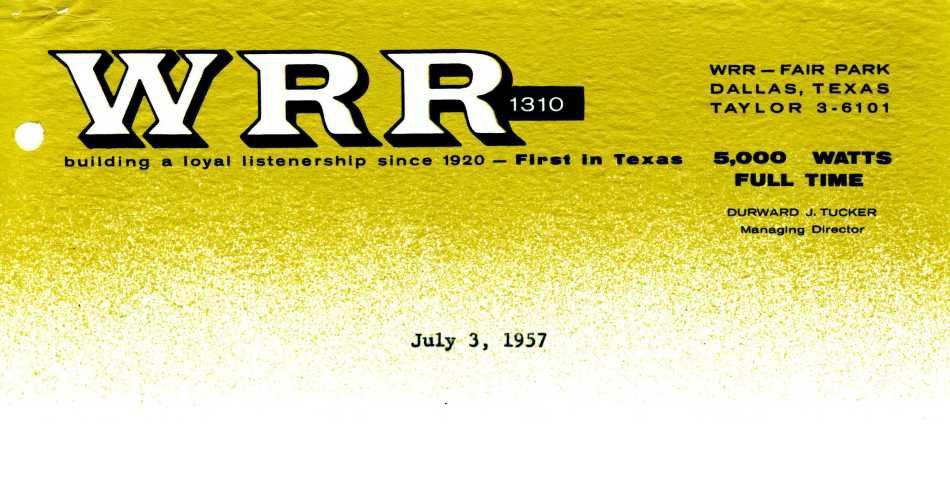
When you think about Radio and Dallas in the 1950's, one name that comes to mind is that of Durward J. Tucker, W5VU.
Mr. Tucker served his community in the highest standard. Besides being managing director of WRR AM 1310 where he had worked since the 1930's, he was in the National Guard in the 1930's and was a Dallas Police officer during WWII (he was the trustee for the DPD ham club station for many years). He wrote a basic electronics book circa 1941 (An Introduction to Practical Radio), that he used in a course taught during WWII to train people for the Navy Radioman entrance exam. He taught electronics evening classes at Dallas Technical High School in the early 1940's and was Chief Engineer of the Dallas Municipal Radio Department, which installed and maintained radios in the city's police cars. He held the rank of Lieutennant Colonel in the Texas State Guard in the 1950's, and was Director of Civil Defense Communications in Dallas at that time. The CD office was in the WRR building at Fair Park.
An active amateur radio operator, Durward built many radio equipments including two 1-KW transmitters, and originated some innovations which were written up in QST during the 1930's. He wrote a series of RTTY articles for CQ magazine in the 1960's. Since he had written so many articles, CQ magazine did a bio entitled "Who is Durward J. Tucker?".
Durward was mostly a DXer (phone almost exclusively), and a contester (he often won Sweepstakes for the North Texas region). He wrote a book on RTTY (RTTY from A to Z, published by CQ Magazine).
Although Durward passed away in 1991, The later of two KW transmitters he had built survives to this day. The earlier one was also very robust and was built in the 1930's. When WWII began and ham radio was shut down, there was a shortage of civilian commercial broadcast equipment. He ended up selling that transmitter to a AM radio station that needed a transmitter. The early KW's whereabouts are unknown at this time.
The "Tucker Transmitter", as the later KW was known on the AM nets of the day, was legendary for its clear, clean audio and strong signal. The beautiful transmitter was built over a two year period at the WRR AM transmitter location (at that time on Flag Pole Hill near Whiterock Lake), completed in 1957, and moved to his home nearby. He put up a 100 foot tower there and had respectively 3, 4 and 5 element monoband Telrex beams for 20, 15, 10M and a prop pitch motor (from a B-29 bomber) to turn them.
The transmitter was built like a commercial AM broadcast transmitter, to loaf along at ham power levels, on AM, with a duty cycle of 24/7/365. The main power transformers are pole transformers obtained from Dallas Power and Light.
In addition to the 160-10M ham bands, the KW has a bandswitch position for 2726KHz, a Texas State Guard frequency. In those years, TXSG soldiers were issued old jeeps with radio equipment of the same vintage. His mobile TXSG call was KKE397 AQ4.
After his death in 1991, the Tucker KW was donated my Mrs. Tucker to the Texas Broadcast Museum at the Dallas Communicatons Complex, but through poor management and carelessness, it ultimately ended up in a scrapyard where it languished in a filthy rat-infested building for several years, while the undocumented workers at the location made a game of throwing their lunchtime chicked bones at it from across the room, with the goal of getting them into the top of the unit through a missing ventilation screen..
I heard about this 'monster transmitter', and found out where it supposedly was. As soon as I saw it, I knew it would be my duty to haul the beast home and get it on the air. It wasn't an easy job though. At well over 1500 Lbs, the RF deck and the modulation transformer (and about 30 lbs of chicken leg bones -I kid you not!) had to be removed in order for the groaning lift gate on the pickup truck to do its job. And that was with 2 guys helping!
Room was hastily made in the garage, and the unit shoved in. This bring the story to the current state of affairs. It's time to clean out the garage and get started on the transmitter.
"1 KW Transmitter", By Durward Tucker; private collection of G.E. Tucker
"RTTY from A to Z", By Durward Tucker; published by CQ Magazine
"Low-Cost Crystal Control for High Power", QST JUN 1934
"Partial Application of Crystal-Lock System", QST OCT 1934
"Types of Distortion in 'Phone transmitters", QST FEB 1936
"Amateur radio Stations", QST JUL 1936
"Star Spangled Radio" By Ivan Saddler
"Who is Durward J. Tucker?", QST