Solid State Replacements for 5R4, 5U4, 5Y3, and others.
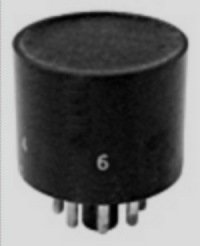
location south top shelfThese FAA-rated plug in solid state replacements are designed to replace all variants of the 5R4 specifically including military-industrial rated tubes. PIV is 1400V, RMS voltage rating is 1000VAC per plate. The internal diodes are rated 1A current. Just plug them in.
These can also replace many older types and smaller tubes. In rare cases, the AC voltage at the plate pins needs to be checked to make sure it is not too much, or the socket may need some rewiring because of pin-out differences. In some cases manufacturer made an electrically identical tube with a different pinout to force users to buy replacements from them only. Oh yeah, "Brand Protection" has been going on from the beginning, but now some of those tubes are very scarce.
What you must do, for non-5R4 tubes:
1.) Check the socket wiring. You may have to move the filament/B+ wire or the plate wires from one pin to another. It's reversible, for purists.
2.) Check the AC voltage at the plate terminals. These rectifiers handle 1400V peak between anode and cathode. That is 1000V RMS on your meter. Usually, the voltages are quite lower, like 400-800V RMS per plate and the rectifier replacement is fine. Please be careful.
Notes for all tubes:
1.) You may wish to add a series resistor when going solid state because you get a bit more voltage with these than with the original vacuum rectifier. The increase is usually 20 to 60 Volts.
2.) No filament current is required. In some cases you may want to move the B+ wire to a specific filament pin so that the B+ does not have to go through the transformer's filament winding. Sometimes a slight difference in hum can be obtained from one or the other connection.
3.) The solid state replacement is only for circuits having a dual rectifier with a common cathode or filament. The replacement has only one cathode internally, so it will not work where an original dual rectifier tube used its cathode separately or where they were not connected together.
As a courtesy, the official JEDEC specification for each of those tubes is linked so you can judge for yourself. If you don't understand whether the solid state replacement will work for your application, please e-mail the administrative contact for technical support with your questions.
Appearance may vary (some taller, some metal) on these surplus items removed from working military and FAA equipment.
Tested Good FAA/military pulls $5 each or 5 for $20 or 10 for $35.
NOS sealed in original packs: $10 each or 3 for $25 or 10 for $60.
Appearance may vary from image.
The list below contains common Octal tubes that might be replaced by the FAA solid state rectifiers. Voltage ratings of the vacuum tubes are shown in order to alert the you as to when a voltage check is needed. If the voltage shown is 1400V or less, there is no need to check it, as long as the original equipment was properly designed.
- 0Z4 880PIV
- 3DG4 1050PIV
- 5AR4 1500PIV
- 5AS4 1550PIV
- 5DJ4 1700PIV
- 5R4 1400PIV
- 5T4 1250PIV
- 5U4 1550PIV
- 5V3 1550PIV
- 5V4 1400PIV
- 5W4 1100PIV
- 5X4 1550PIV
- 5Y3 1400PIV
- 5Y4 1400PIV
- 5Z4 1100PIV
- 6H6 150PIV (sub only as rectifier. Not for signal diode use.)
- 6X5 490PIV
- GZ34 1500PIV
Lastly, there are many non-Octal tube rectifiers that can be replaced by these rectifiers, including lower-powered Mercury vapor types like the 82 and 83. It is always possible to create an adapter, for example, to use the solid state replacement with a Loktal or 4-pin rectifier socket. The accepted method is to salvage a base from a worn-out tube by unsoldering the pins and removing it, and then adding an Octal socket on top of it. because of the generally low-profile of the FAA-rated solid state replacement rectifiers, there is no issue with fit. The same caveats apply for voltage ratings.
Easy to use tube manuals are provided for your convenience and should cover most of the rectifiers:
Sylvania 1943
Sylvania 1949
RCA 1966